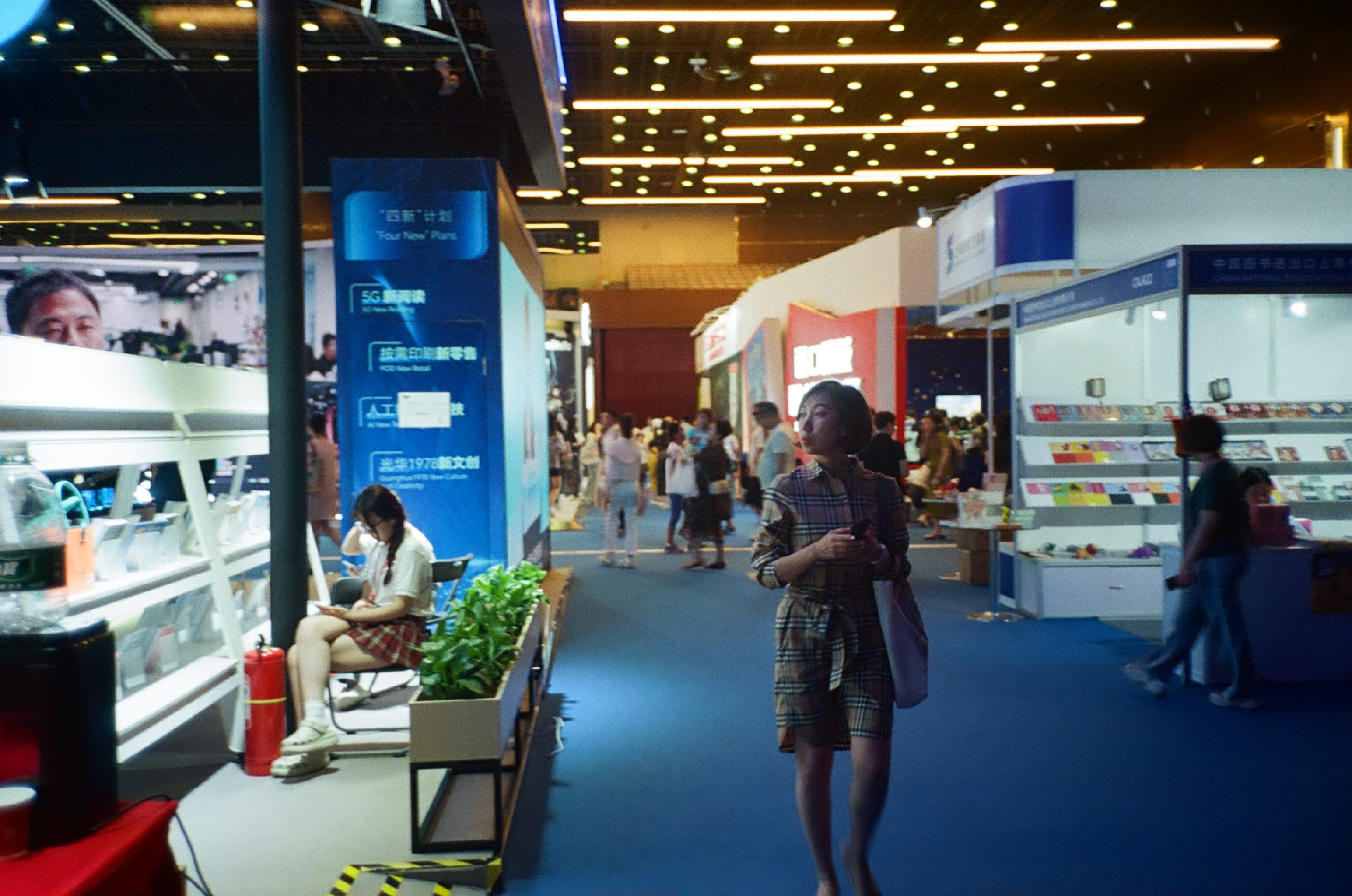
Book fair

Near the beginning of March, Cedric Samuel realized that he had given up on his daily bicycle rides along the Arakawa that he had persisted at through the winter. The trips that had carried him across the bridge into the suburbs, became tours of the riverside, and then brief sprints along the tram line. He began walking instead, sometimes as far as Ikebukuro, or as far as Minami-Senju.
Near the end of April, Cedric Samuel realized that he had given up walking in the city. When the summer came, Cedric Samuel rarely left his room, unless it was to buy groceries.
Cedric Samuel imagined that he lived like a monk. His room was mostly empty. There was a thin mattress on the tatami. He could have rolled it up, but he never did. He moved it each night before bed to another place on the floor before mold could grow under it. Against the walls were a pile of clothes, a pile of books, a few books, tissue boxes. Everything else was in Ayumi’s father’s house in Chiba. The night before he had left, he had loaded all of his possessions into a cardboard box, taped it up, and told Ayumi to throw it away. But she sent the box to her father, she told him, later.
Cedric Samuel could never remember the names of the two men that lived in the other bedrooms in the sharehouse, even though they had done him many kindnesses. They had each asked once if he were a student, which made him chuckle the first time, then laugh the second time. He saved his confessions for the meetings, and for the men that he met afterwards in Thai restaurants, to eat green curry and share inspirational slogans.
Cedric Samuel waited for a year to leave Ayumi. That was one of the things that the men had told him. In the first year, he should make no major changes in his life. He had come to realize that he hated himself more than could ever be alleviated by her kindness or devotion. He had come to realize that she feared him more than she loved him. And he had come to realize that she was an unhappy person and that he would go mad if he thought he could make her happy. So, when things seemed peaceful, he told her that he was going to leave. She helped him to find the share house room one ward away.
The two nameless men didn’t know any of this, though. Cedric Samuel didn’t ask what their lives were like. From what little he could observe, they went to work early in the morning, and arrived home in the evening. They ate, in their rooms, alone, while drinking cans of beer, tinned pickles on rice, corned beef on rice, moyashi and ground pork on rice, or instant noodles. That he was a foreigner was not important to them, Cedric Samuel believed. His conversations with the men were never long or complex enough to reveal that his Japanese was rudimentary. They wrote notes to him in English. He followed the rules that he sensed they followed. Although they were both Japanese, they seemed just as alienated from one another as Cedric Samuel was from them.
The house was silent, except when it creaked gently, shaken by the passing of the tram headed for Minowa or Waseda.
Cedric Samuel decided that he would devote one final summer to accomplishing something worthwhile. He was in his fourth month of sobriety. Without the binges, when he seemed unable to control how much he spent, the money he had been paid for translating Li Gu’s novel would hold until October or November. Cedric Samuel decided in May that he could write a novel about his year in Inner Mongolia. In June, he was sure that he could produce a fictionalized version of the life of Yasuda Yasuyuki, which would also serve as a revisionist history of the Lod Airport massacre. In July, after he had given up on both of those schemes, he devoted himself to translating Yu Dafu’s journals into English.
Cedric Samuel, at first, sent these translations to his colleagues, then only to Sara, since she seemed to appreciate them.
Sara was more famous in her own country than Cedric Samuel was in his. Cedric Samuel had never spoken to her, but they had been in the same room before. There were only a couple dozen or so notable translators of contemporary Chinese literature. Cedric Samuel and Sara had places on that short list.
Cedric Samuel tried to remember how she had spoken. There was nothing there.
Cedric Samuel put her name transliterated in various alphabets into various search engines. He read an interview with her, conducted by local newspapers. She talked about building bridges between civilizations. Cedric Samuel had said the same sorts of things, too, the few times anyone interviewed him.
Cedric Samuel learned that Sara’s father was an engineer, who had trained in the Soviet Union, and her mother seemed, based on what he could parse through translation software, to have disgraced her aristocratic family by joining a dissident political faction. Sara’s father had told her that studying French was a dead-end. Sara had gone to stay for seven months at a college in Weihai, where she had translated a book of poetry by the dean.
Cedric Samuel studied the few pictures of Sara that were available on the internet. She had skin pale enough to show the freckles across her nose. Her mouth was wide and her lips always set together. She wore a man’s Rolex. She had gray in her hair. He scrolled back on her Instagram until she was no longer an elegant woman, posing with Chinese poets, but a girl, studying in Paris. Her nose had been pierced with a gold ring, then.
In June, when Li Gu’s wife sent him a message on WeChat to invite him to Beijing, Cedric Samuel agreed. The reason that he believed that he accepted was because he wanted to absolve himself of his ambitions. It only occurred to Cedric Samuel later that he might be able to see Sara. She would go to the Beijing Global Publishing Fair because she went every year.
Li Gu’s wife told him that Li Gu was curious about him. Li Gu lived in London, but he would travel back to China for the Beijing Global Publishing Fair. She told him that she needed to find someone to pay for the trip, so he would need to agree to join one of the programs put on by the China Consolidated Publications Control and Promotions Group for the Beijing Global Publishing Fair. It would be a formality, Li Gu’s wife thought. He could fulfil his obligations by joining a panel with Li Gu and other translators of Li Gu’s novels. She told him to wait for a call from Zhou Wenjin of the China Consolidated Publications Control and Promotions Group.
Zhou Wenjin called Cedric Samuel on WeChat the next morning. Cedric Samuel had met her before. He had known her since she was a junior editor for one of the China Consolidated Publications Control and Promotions Group’s trade magazines. He knew that she knew he would agree to most of her suggestions. He tried to come up with an excuse to arrive late, to skip most of the talks and panels that she proposed. He wanted to give her an excuse that she couldn’t question. The excuse that Cedric Samuel came up with was that he had a lover and that his lover was pregnant. Zhou Wenjin said: “When is she due?”
Cedric Samuel scrambled: “August.”
Zhou Wenjin insisted: “Then it should be okay to leave her for a few days.”
Cedric Samuel didn’t have a lover. He didn’t want to imagine Ayumi, so he pictured the woman he had met at the girls bar in Shinsaibashi who wore a patch over her right eye. In his memory and in his imagination, she was uncommonly beautiful. Cedric Samuel could not remember her name, so, instead, he called her Haruka, which was the name of a woman with a fat, tiny nose that he had met a year before in Shimokitazawa, for whose kiss he had humiliated himself. In his imagination, Haruka’s tanned belly swelled with his child and its underside was streaked with stretchmarks, and she was beside him on the tatami, dressed in white Family Mart bra and panties, moaning softly about some discomfort that she was unable to fully explain. She reached out for him. Cedric Samuel pleaded with Haruka for just a few days in Beijing. Haruka moodily acquiesced. Cedric Samuel told this to Zhou Wenjin.
Cedric Samuel drafted, then rejected messages to send to Sara. He wanted to know if she would be at the Beijing Global Publishing Fair, but Cedric Samuel was too shy to ask her, because he knew she would say she was coming. He decided to ask her for advice on translating Yu Dafu. He decided to ask her what she thought about Li Gu.
Cedric Samuel took out his notebook for the first time that day while sitting in Mitsumoto Tei in Narita. He maneuvered it on the table so that it didn’t touch the puddle of condensation around his glass of cream soda. He only wanted at first to flip through its pages as a distraction. He read directions he had written for himself, years before, to walk from Nanjing Road to the Grand Central Hotel in Shanghai. He couldn’t remember whether or not he had actually made the trip. He read notes he had made for a workshop in Xi’an. They made no sense to him. He had forgotten everything he had ever read about translation theory. He forgot whether or not he had used the notes. On the next page, he found descriptions of the clothes that his students in the workshop day had been wearing, written as they took turns reading from their thesis abstracts. About one boy Cedric Samuel wrote: His face looks so soft. On the following pages were sketches of an American translator named Michael Tremblay. He was an old man. He was a businessman that became a Sinologist when he divorced his wife and moved to Penang. Cedric Samuel visited him in Penang. Michael Tremblay visited him in Tokyo. In the sketch, Michael Tremblay was nude, standing with one hand raised, a palm extended. Cedric Samuel had drawn it on the bus home, after seeing Michael Tremblay back to his hotel, and sharing the onsen with him. As they had stood naked together in the locker room, Michael Tremblay had reached out and lifted Cedric Samuel’s penis, his thumb and forefinger around the circumcision scar. “It doesn’t make you uncomfortable,” Michael Tremblay had said. The memory was the sort of distraction that Cedric Samuel wanted.
Cedric Samuel turned to a blank page. He wrote: Dread being flown business class. He turned the page and wrote: NARITA Mitsumoto Tei canned mushrooms frozen peas beef pulled frozen from a box shipped in from NEBRASKA. Dried parsley. I can be nostalgic for this, too. He flipped back a page and wrote: I don’t want to stare at a bulkhead. A line down: Memorial to the last generation of Korean Air flight attendant uniforms. He tried to come up with a description of the particular blue of their jackets. He blotted it out with hashmarks, and then wrote below: A carton of Lucky Strike smallest purest bottle of Terre d’Hermès. X’s advice to his fellow martyrs: accept the glory of death and spray cologne on your throats. Strip club the night before. I will arrive in Beijing with my jacket smelling of stale smoke sweat and my collarbone bergamot vetiver cedar sweat. Sara. No need to write her name. He crossed it out. I hope only to glimpse her. For a year that sustained me. Last year it was the third floor of the convention center, in the crowd. She was talking about her translation of Ertong. I picked up the original and tried to do it myself, just a few poems. So, she is brilliant. I would be satisfied if I could speak to her. He stopped writing.
In a middle seat on the twelfth row of a Japanese Airlines flight to Beijing, Cedric Samuel thought about Sara. The last time he had seen her: The third floor at the convention center, to celebrate a book by Xu Lejiang. He sat on a panel beside an Iranian woman. Cedric Samuel had seen Sara after. He had been unable to work up the courage to talk to her. They knew the same people. She sent him a message on Twitter. They exchanged emails. They talked in a way that meant never arriving at any conclusion. Sara told Cedric Samuel about studying English literature. Cedric Samuel told Sara about not leaving his room for a month during the pandemic. They talked about translation. Cedric Samuel was afraid to tell Sara that he thought she was beautiful. He hoped she might assume by his noncommittal devotion that he adored her. Cedric Samuel was not sure what else he could do. There was nothing he could do. When he didn’t drink, he remembered women he had loved. There was Ayumi. In his mind, she was always in bed, nude under the duvet, trembling because of the risperidone. There was Abby. In his mind, she was across the campfire. There was Liu Guangrui. In his mind, they were in the bathroom of her parents’ apartment near Fuzimiao, making love while her father swore at the television and her mother made lunch. When he drank too much, he went out and found other women. There was Haruka—the real Haruka, from Shimokitazawa—who he met only once and kissed. There was Kitty, the lecturer at Bard who Cedric Samuel thought about while Michael Tremblay was on his knees in front of him. When he couldn’t find women, he typed messages to women on his phone. There was a woman in Boston, who could sing like an angel, who was so beautiful and so sad, who was studying urban planning and wrote an essay on Substack about Henri Lefebvre, the shade of streetlights, and Song poetry. Cedric Samuel was careful not to send messages to Sara when he drank, because he feared that he would be too bold. Cedric Samuel feared that he would say to her that he could not stop imagining what it would be like to kiss her. Even if she were to be alarmed, he suspected she might continue to be polite. Even if she were polite, and even if she were flattered, there would still be nothing that he could do. Cedric Samuel decided to close his eyes and pray. “God, please keep me sober,” Cedric Samuel said in his own head. And then he made an abstract prayer about Sara, which was not expressed in words.
Beijing felt different, when Cedric Samuel got inside, but the entrance was always the same. He walked through gray corridors into a wide hall, then another corridor. There were more cameras than the last time, maybe. High ceilings. Rows of barriers to mould the crowd. Cedric Samuel felt sweat under his arms. He felt his pulse in his temples. Cedric Samuel never enjoyed crossing borders, and he particularly feared crossing into China at Beijing. There was no reason. The guards never asked his reason for coming to the country. Cedric Samuel wondered if they knew. He hoped they knew.
The guard stamped his passport. Cedric Samuel walked through the gate. He took the train to the next terminal. A driver with a sign bearing the logo of the China Consolidated Publications Control and Promotions Group met him and led the way to his car. On his way, he asked Cedric Samuel, in English, “Can you speak Chinese?”
“Uh-huh,” Cedric Samuel said.
“That’s good,” the driver said, in Chinese. But they didn’t speak again. The car was an electric sedan. The air conditioning was cold. Cedric Samuel looked out the window. It had been a year since his last time in Beijing.
Cedric Samuel reminisced. He remembered the first time that he had ridden in a car from the airport in Beijing. He flew that year from Oklahoma City to Denver, then Denver to San Francisco, then San Francisco to Beijing. He had another flight scheduled, down to Shanghai, where he had a hostel room booked, then a dormitory cell waiting for him. But his bags didn’t arrive in Beijing. He missed the flight to Shanghai. He walked out into the terminal and a taxi driver sidled up to him. “Hotel,” Cedric Samuel said. The driver took him into the city. Cedric Samuel stayed there for four days. He slept with a prostitute from the hotel’s sauna. Cedric Samuel showed her the money that he had earned selling his Camaro, so she called another woman for him. The three of them rolled naked on the bed, glorying in the air conditioning. It lasted for three hours. There was nothing left to do after that. Cedric Samuel walked on Wangfujing. He took a picture of the blocklong mural of Kobe Bryant. He took a picture of a foreign man fumbling with a map. He bought a bottle that looked like a local parody of Red Label, and drank it with Coke in his room.
But he only reminisced for himself. Cedric Samuel saw that the driver was already on a phone call. Cedric Samuel picked up his phone. There was a message from Sara. She asked him what time he was landing. Her flight from Doha took ten hours, she said. She had to fly over India. She asked him what hotel he was staying at. He paid attention to the messages. He forgot the city slipping by outside. He wasn’t sure where he was going. The driver pulled up in front of the hotel. Cedric Samuel took his bags and walked inside.
Cedric Samuel paced the room. He turned on the television and flicked between RT and CNA. He hung his clothes in the closet. He washed his shirt in the sink, wrang it out, and hung it over the bathtub. He put on a pair of jeans and a T-shirt, then went for a walk. He was on a street that only had hotels on it, running along a low river with concrete sides. Outside, the late afternoon smelled like the synthetic cedar from hotel lobbies. The bridges across the river were lit with purple and green lights. Cedric Samuel walked until he came to a hospital for Chinese medicine. The street smelled like licorice, mugwort, angelica, and clove. He crossed a bridge and came to a square. The sun was setting. He watched kids filming each other doing kickflips. He watched a man launching a glowing bulb up into the sky with a slingshot, then catching it as it fell. He watched women dancing. A man sidled up to him. “This is a Chinese song,” the man said. He spoke English. Cedric Samuel nodded.
“Do you like this song?” Cedric Samuel asked.
“I like,” he said. He saw that Cedric Samuel was smoking. “American cigarettes?”
“American cigarettes, made in Japan,” Cedric Samuel said, switching to Chinese.
“Nobody can beat China now,” the man said, switching to Chinese, too. “We were beaten by so many countries, even the Japanese.” He gestured at the cigarette in Cedric Samuel’s hand. “But nobody can beat us now. We don’t want to interfere with other countries, either.”
“That’s right,” Cedric Samuel said.
“What country are you from?” the man asked.
“I’m American,” Cedric Samuel said.
Even though the man frowned at this, Cedric Samuel decided it would not be appropriate to begin explaining what his nationality meant to him. He knew it would be meaningless to claim that he didn’t feel American anymore, after so long away. He couldn’t explain that he had no hometown. He wouldn’t say that he had been to Stuttgart and Naha but not New York City or Los Angeles, or that he had lived most of his adult life in Shenyang, Vancouver, Mombasa, and Tokyo. His exculpatory evidence wouldn’t hold any weight. He was American.
“You are American,” the man said.
“That’s right,” Cedric Samuel said. He offered the man a cigarette.
Cedric Samuel went back toward the hotel by another route, across another bridge. He stopped at a restaurant selling banmian and ate a bowl. He went back to his room. He sent Sara a message, asking her what she needed to do the next day. She was going to sit on a panel about Middle Eastern literature in Chinese translation. She didn’t know what she was going to say. He said that he was going to give a talk about the American publishing industry and prospects for the promotion of Chinese literature in translation. He wasn’t sure what he could say. She sent the name of her hotel and he opened Baidu Maps to see how long it would take to walk there. He told her about the banmian. He asked her what she liked to eat in Beijing. She described to him a sort of crisp cornmeal pastry, soaked in honey.
In the morning, Cedric Samuel put on a tweed jacket. He drank a warm bottle of Coca-Cola and watched RT. He was greeted in the hotel lobby by a woman from China Consolidated Publications Control and Promotions Group. She addressed him as laoshi and lay over his head like a garland of flowers a card on a lanyard. The card identified him as a “Sinologist.” They rode together in a taxi across town. The name she gave was Julie. Her family name was Zhu. She was in her twenties and wore her hair short. She wore glasses. She sat in the front seat and turned around to speak to him: “I wonder, laoshi, if I can ask you a few questions about translation.” She spoke Chinese.
“Yes,” Cedric Samuel said. He spoke Chinese.
“When you want to translate a book, who do you talk to first?”
“I try to contact the author. I ask for permission. I ask about the rights, but not formally—just to see if the situation might be complicated.”
“And then who do you take the book to after you translate it?” Julie Zhu asked.
“I don’t translate it. I find someone that might be interested. If they will pay me, I can translate it.”
She turned around again, then turned back, and asked, “How did you know Li Gu’s books? How do you find books you want to translate?”
“I read Douban,” Cedric Samuel said.
“I read Douban, too,” Julie Zhu said.
“Which writers are you reading now?”
“I liked the last Wang Zhanhei collection,” Cedric Samuel said. He was sure he had not read it in full, so he hoped that Julie Zhu would not ask him more about it. He glanced at his phone to see if Sara had replied to his last question. “Ban Wang,” he said, “I like him. I’m reading Hu Lingyun’s book.”
“I don’t know him. Do you read old books?”
“I like Qiu Huadong,” Cedric Samuel said.
“What is he like?”
“He wrote a book about an artist coming to Beijing. He wrote about the suburbs.”
“Who is he like? I mean, which Western writers is he like?”
Cedric Samuel paused for a long time. “Maybe he’s like Jack Kerouac sometimes. I never thought about a comparison. What do you read?”
“I read Western literature,” Julie Zhu said. “I read Kerouac. He wrote On the Road, right? He wrote another one. Dharma something.”
“Dharma Bums.”
“I like Nabokov,” Julie Zhu said. “I read old books. I like Donald Barthelme.”
“Pale Fire,” Cedric Samuel said, remembering the Chinese title. He had never actually read it.
“Did you ever write a novel?” Cedric Samuel asked her. He wanted to ask the same question to Sara. She must have. He had told every woman that he had ever fallen in love with that she should write at least a short story. But he wouldn’t need to tell her. She must have.
“No,” Julie Zhu said, “I never write my own stories.”
Cedric Samuel wondered if she was lying. If given a pen and a blank sheet of paper, or a blank word processor document and a keyboard, what would she put down—a list, maybe, or a recipe?
They rode the rest of the way in silence. Cedric Samuel turned back to his phone.
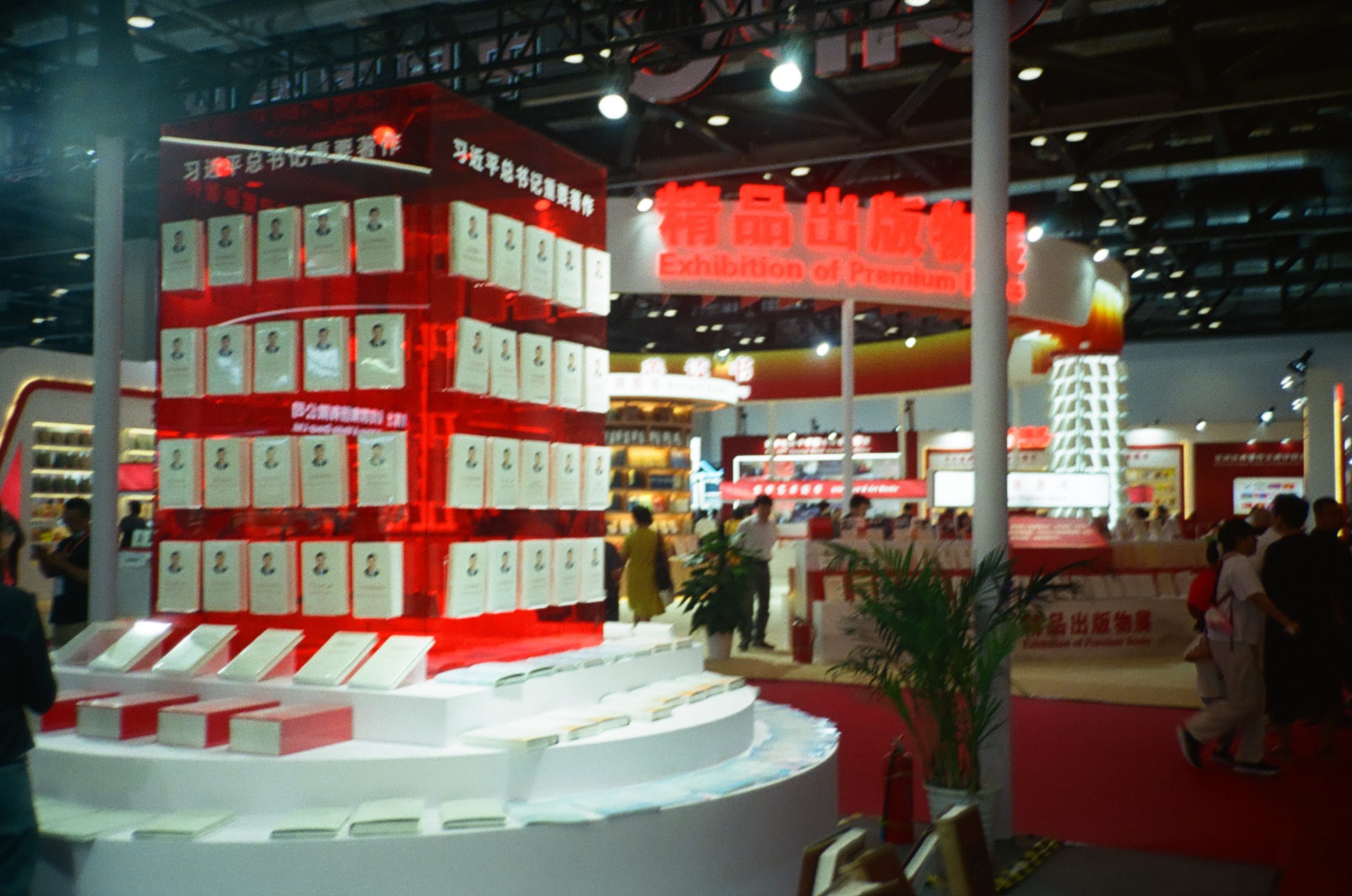
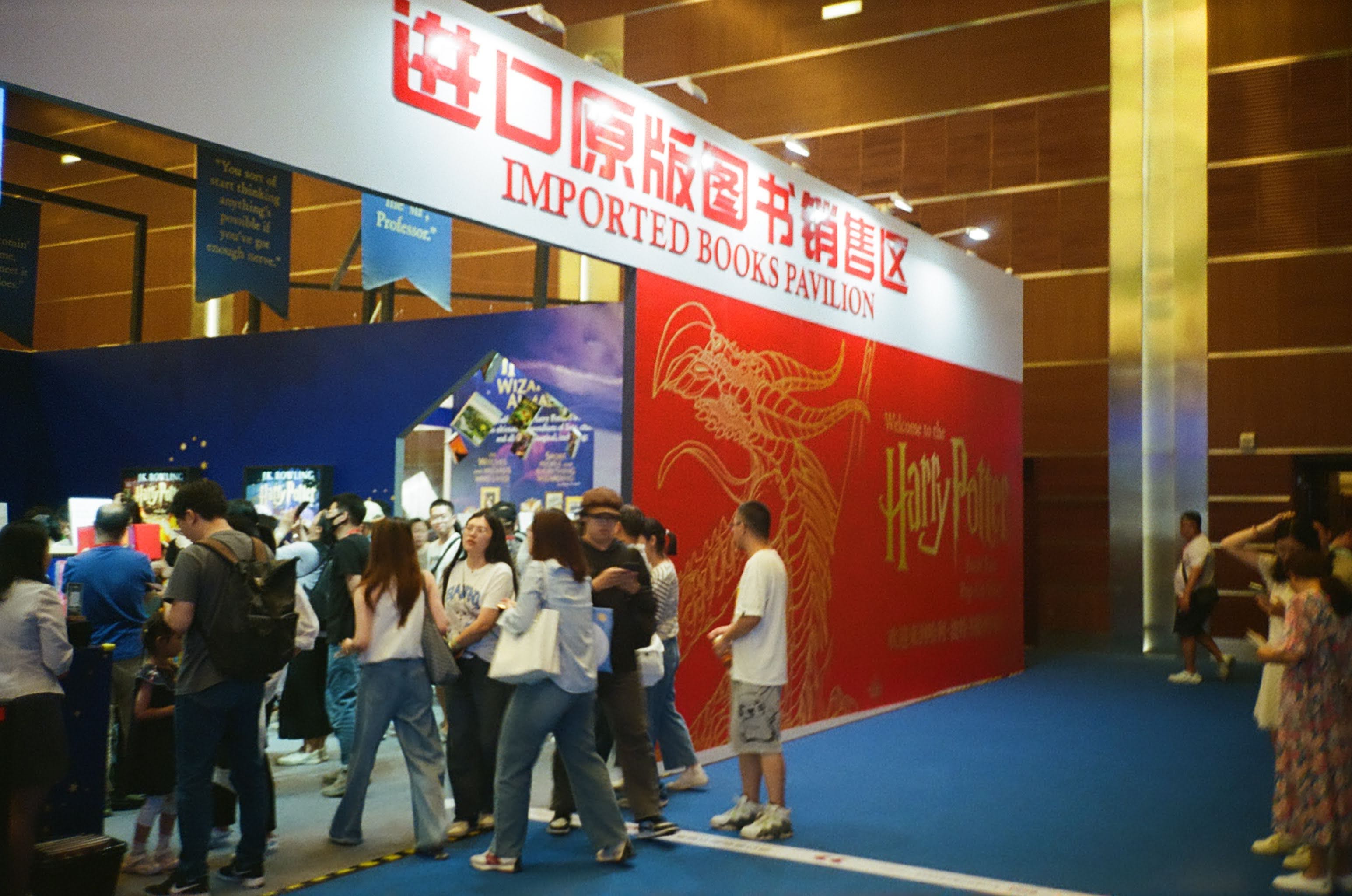
Julie Zhu followed Cedric Samuel as he walked across the square. The sun shone down and radiated back up at him. She unfurled a parasol. She tried to hold it over him. He told her that he wanted to feel the sun. She pointed out the Bird’s Nest, the Water Cube, the Olympic Tower. They went into the convention center. “Do you need water?” Julie Zhu asked. He said he would be fine. She led him through the exhibitors’ halls. People’s Literature and the Saudi Arabian Arts Bureau. Kodansha and Taschen. Everything was made of styrofoam. Particle board. It could be pulled down in a hurry. Men in business casual. Women in business casual. Wide screens, broadcasting words of support from publishers that didn’t make the trip. Julie Zhu led him down into the basement, which was reserved for more minor guests, like the Light Industry Publishing Company of Hebei, an Italian picture book publisher, and the Social Sciences Press. He was set up in a corner, and told that he would speak in fifteen minutes. He sent a message to Sara, asking her where she was. She asked him where he was. He looked at his notes. He greeted a man from Libya, who apologized for his poor English. He greeted a man from Syria, who apologized for his poor English. He greeted a blond woman from an American publishing house. It was her first time in Beijing.
Julie Zhu led him to a low stage and pressed a microphone into his hand. Cedric Samuel spoke about the declining audience for literary translation, then, warming to the topic, talked about illiteracy, and the dark age coming. He announced to the small audience, made up mostly of other translators and publishers, that it seemed humanity was doomed. The microphone cut out. Julie Zhu rushed to bring him another one. “There is hope,” he said, “I think.” He regretted his pessimism. “I have high hopes for the future.” He handed the microphone back to Julie Zhu. She smiled at him. The man from Libya spoke next. He began his speech by saying that there was no paper in his country.
Before Cedric Samuel could hear an explanation, Julie Zhu was at his elbow, directing him down a hallway. They entered a gallery where a ceremony was already underway to celebrate the sale of Arabic rights to a book that a Frenchman had published with the China Industrial Press. It was called Imperial Death Drive: The American Monster Unmasked. He was led to a seat on the panel, beside a French publisher and a Syrian editor. On a screen, the author of the book was speaking about how his colleagues had been ostracized for holding pro-China positions. Cedric Samuel was not expected to speak.
Cedric Samuel ate lunch in a corner of the basement of the exhibition center with Julie Zhu, another woman from the China Consolidated Publications Control and Promotions Group, whose name Cedric Samuel didn’t know, a translator named Köksal Toptan, and a translator named Tereza Kosinová. At first, the conversation was divided between two genders: Julie Zhu and the unidentified woman from China Consolidated Publications Control and Promotions Group and Tereza Kosinová talked together, mostly in English, while Cedric Samuel and Köksal Toptan talked together, mostly in English. After that, the conversation was divided by insider and outsider: Julie Zhu and the unidentified woman from China Consolidated Publications Control and Promotions Group griped about rivals and bosses, while Köksal Toptan and Tereza Kosinová talked about, generally, academia. Köksal Toptan was an academic, but he had become moderately well-off because of translation. His translation of a collection of abridged classical texts sold in the millions. He appeared on his country’s state-run television network to hold forth on relations with China. He was invited on China’s state-run television to hold forth on international relations. Tereza Kosinová was an academic. She translated contemporary poetry for government grants. Cedric Samuel was younger than Tereza Kosinová and Köksal Toptan by, he guessed, about twenty years. It seemed that they had known each other for many years. There was something sharp in the way that Köksal Toptan spoke to Tereza Kosinová, as if he was instructing her. He let on that his students did most of his work. There was something resigned in the way Tereza Kosinová spoke to Köksal Toptan. She let on that she was nostalgic for the socialist system, for her years as a student in Beijing, and for all the time that had gone before.
Cedric Samuel wanted to join the conversation, so he asked Köksal Toptan and Tereza Kosinová how and why they had come to study Chinese. Köksal Toptan had a story about falling in love with Zhuangzi as a boy. Tereza Kosinová said that her grandfather had been friendly with Lu Xun during his time in Shanghai. Her father was an Orientalist, too. She had no choice.
Cedric Samuel told them briefly how he had gone to study in China because he so badly wanted to leave his own country, and there were no better options. He did a semester studying Chinese in Nanjing. He took a Chinese government scholarship to go back. He didn’t tell Tereza Kosinová and Köksal Toptan that he had fallen in love with a woman in Nanjing, then, and wanted to learn Chinese because he believed it was the only way to truly know her. Her name was Liu Guangrui. He didn’t say that he had become a translator of Chinese literature for the same reason.
Liu Guangrui had an unbowdlerized second edition of Unsettled Remains stashed in the bottom of the suitcase she had dragged off to Nanjing. Aware of its reputation for eroticism, Liu Guangrui had, many years before Cedric Samuel met her, and found the book wrapped in a supermarket flyer, buried under her winter things, stolen her copy from the bottom of a friend’s father’s stack of martial arts paperbacks. Cedric Samuel wanted to know what the book was. “Do you know Tropic of Cancer?” she asked him. “It’s like that for us, but more serious… The language is old language.” He asked her to read to him from the book, and to translate for him what she read. The English she had learned from the Voice of America was insufficient. But Cedric Samuel and Liu Guangrui sat on his bed together, and she read, and he wrote.
When he went back to the States the second time, Cedric Samuel thought he could take an analyst job at some lesser intelligence agency. He imagined his job would be reading Chinese newspapers.
That afternoon, Cedric Samuel sat on a panel called “A Dialogue with the World: Respected Sinologists Discuss Li Gu in Translation.” He was seated beside two stern-looking men, both about fifty, and both in navy-blue jackets and light blue shirts, one of whom had translated Li Gu into Italian, the other into Portuguese. The host was an enthusiastic young man of about thirty, who wore a Uniqlo polo shirt. He asked each panelist in turn to introduce themselves. The Portuguese man and the Italian man both spoke in Chinese. Cedric Samuel followed them. He used up as much time as possible thanking his host, the audience, and the China Consolidated Publications Control and Promotions Group, and the organizers of the Beijing Global Publishing Fair.
The Italian man seemed unfamiliar with Li Gu’s work. He spoke in general terms about the power of literature. He was excited that Li Gu was being read by Italians, who seemed eager to learn more about the Chinese people. The Portuguese man seemed unfamiliar with Li Gu’s work. He spoke in general terms about the victories of the Chinese people and made reference to the forty-fifth anniversary of Reform and Opening. He talked about Li Gu as a pioneer in the reform of modern literature. Cedric Samuel began telling the story of the first time that he had come to Beijing. He said that he had stayed in a hotel in a hutong north of Wangfujing. It was in the years before the Olympics, so everything was under construction. Cedric Samuel wondered what the reaction would be if he began to weep. There were a dozen or so people in the chairs below the stage, then about the same amount beyond the cordon. He told them that he was coming back to a city that had changed beyond the imagination of anyone that saw it twenty years before. The pause went on long enough to signal that he was about to reach his conclusion. Cedric Samuel explained that he believed something similar to Beijing’s transformation had happened in arts and literature over the same period, that Li Gu stood as one of the towers on their skyline. The host thanked Cedric Samuel.
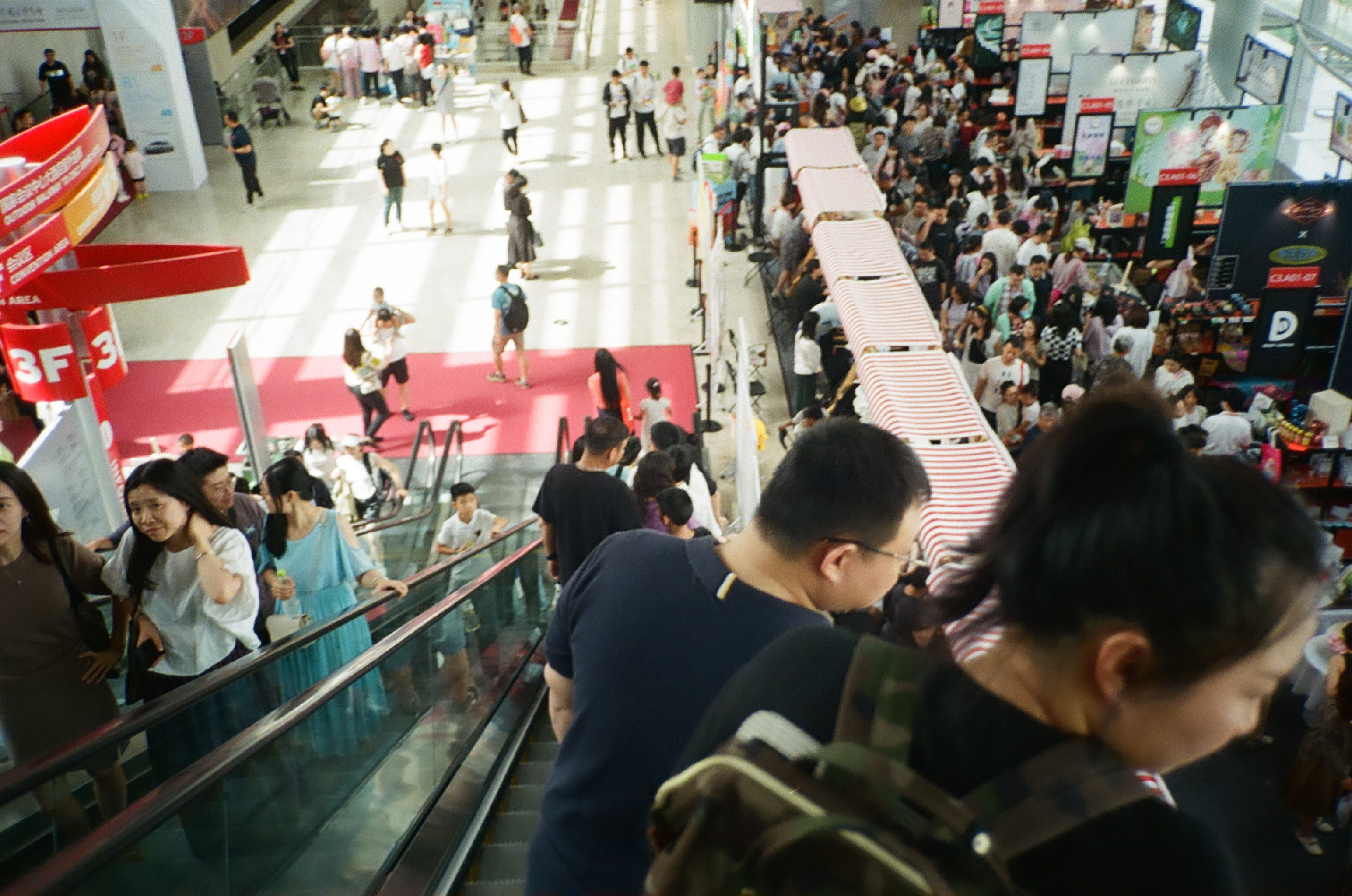
When the discussion concluded, Cedric Samuel told Julie Zhu that he would walk on the square. She let him go. He took the escalator to the third floor. He sent Sara a message, telling her where to find him. He sat on the sill of a window. He waited. Two women were sitting beside him, in the next window over, speaking Mongolian. He watched Sara pass once, then called out to her. He touched her hand. He did his best to seem hesitant to commit to anything to which she would not commit. But Sara wore cedar and oud at her breast, and rose and patchouli in her curly hair. She wore gray. And Sara was more beautiful to Cedric Samuel than he could have imagined she would be. She settled down on the window sill. They talked about being Sinologists. It was a polite conversation. It was restrained. Sara told Cedric Samuel facts about herself that he had committed to memory, about her father, about Weihai. They talked about people they knew. They said they admired each other. Cedric Samuel was unsure of what else he should say to her. They made plans to meet for dinner.
That night, Cedric Samuel and Sara ate dinner together at a Yunnan restaurant in Dongcheng, in an old courtyard house. They sat at a table that caught the sloppy rays of the setting sun. Sara’s eyes glowed light brown. When Cedric Samuel met them, she smiled, to challenge him.
Cedric Samuel had been to the restaurant before. It had been with Caicai, years back, who had come to him at the Beijing Global Publishing Fair and begged him to translate her father’s book of short stories. Cedric Samuel had no interest, but he wondered if he could sleep with her. He invited her to his suite in the Grand Mercure. She poured her heart out to him. She had no happy memories of her father, she told Cedric Samuel. Cedric Samuel lost all interest in sleeping with her. He told her that he would work on the book. They walked that night down to the Yunnan restaurant for a dinner to which he had been invited. Caicai was uncomfortable and left early. He ate dinner with Nicholas, the British translator, and Erica, the American agent, and James, nationality unknown, poet, who lived in a single room in Jiaodaokou with his ex-wife. Cedric Samuel went back to his hotel and studied the bloodprint Caicai left on the toilet seat, and the lipstick print she left on the teacup on the table, and realized that they were the exact same shade of red.
Cedric Samuel kept the story from Sara.
Sara had been to the restaurant before, too. She told him the story. She had been with Ertong and Jacob Birnbaum. Ertong had given a talk at a gallery in Wudaoying. Jacob Birnbaum interpreted for him. They had dinner together afterwards. She didn’t say why she was in Beijing then.
They ate beef and mint salad, toon and dried tofu, and grilled goat’s milk cheese. Cedric Samuel told her about the book he really wanted to write. Sara asked him if he was married. He said that he wasn’t, but he had been before. He talked about how he had met his first wife and what had happened between them. Cedric Samuel asked her if she was married. She talked about her husband and how they had met. Cedric Samuel wanted to know more, but he was ashamed of his curiosity.
Sara told him that she had been invited to Hong Kong by the China Consolidated Publications Control and Promotions Group. She asked him if he had received the same invitation. She was surprised that he hadn’t. She said that she had been invited to the Frankfurt Book Fair. She asked Cedric Samuel if he would go. He said he had never been.
Cedric Samuel told her that he went to church meetings, hoping to lure her into explaining what she believed. She said, “I want to ask you about that,” but she changed the topic quickly.
Cedric Samuel talked about his loneliness. He said that his only friend in Japan had been a real estate lawyer from Dothan, Alabama, who had resolved one day, alone in his Yoyogi apartment, after reaching rock-bottom of a sort of intellectual loneliness, to publish a monograph he had written in French on Gilbert Simondon, to which end he had split up with his girlfriend of several years, quit his job at the Tokyo office of an American practice, and moved to Paris. He asked Sara if she was the sort of person with lots of friends. She said, “You don’t want to know about that,” then changed the topic quickly.
They walked together outside, in the hutong. Cedric Samuel ran out of sensible things to say. He shared his findings on the Lod Airport massacre. They arrived at the train station. He touched her hand again. That night, he sat at the desk in his room and texted Sara about the things he saw on television. He felt no closer to deciding what he should do. He confirmed that it would take an hour to walk to her hotel. He decided not to ask her if he should. He imagined sleeping in the same bed as Sara. When he knew it was too late, he went out to the convenience store beside the hotel, bought a razor and shaving cream, a bag of marinated quail eggs, and a box of condoms. He sat at the desk, waited for the airconditioning to tighten his scrotum, then trimmed away any stray hairs he saw. He shaved the base of his penis. He dabbed away a few droplets of blood with a tissue.
Julie Zhu arrived at Cedric Samuel’s hotel room at six in the morning. Cedric Samuel invited her in. She watched him brush his teeth. She asked if he was going to wear a jacket. It seemed that she didn’t want him to, so he said he wouldn’t. She asked if he had slept well. He told her that the rain had awoken him. He’d had a dream that he was driving down a highway somewhere outside Cumberland, and the sound of the rain hitting the flat roof outside the hotel window had become the sound of insects hitting the windshield. Julie Zhu was worried that he had not eaten breakfast the day before, so, she led him to a room off the lobby and watched as Cedric Samuel filled a bowl with rice porridge and another with pickled radish. She watched him eat.
They rode a car to the convention center. “Laoshi,” she called to him from the front seat, “I want to take a nap.” He told her she should. Julie Zhu slipped off her shoes, curled her feet underneath her, leaned against the door, and was asleep in a few moments. She mumbled in her sleep. The driver woke her as they pulled up out front of the convention center. She slipped her shoes on and sprang out of the front seat to open Cedric Samuel’s door for him. She led him upstairs.
Julie Zhu told Cedric Samuel to speak for twenty minutes on his work as a translator and his collaboration with publishers. His audience was made up of junior employees of the China Consolidated Publications Control and Promotions Group and a few foreign translators whose trips to Beijing had been paid for by the China Consolidated Publications Control and Promotions Group. Cedric Samuel tried to speak in a less cynical way than he had the day before. He talked about how he had wept while translating the final pages of Li Gu’s novel. It was peculiar: he was moved not only by Li Gu’s words, but also by his own interpretation of them. Cedric Samuel admitted that he didn’t know much about translation theory. He said, “But, I think, how I feel about it is expressed in that experience…—as in, if Li Gu makes the reader cry, I would like to make them cry, too, however I need to do it, even if it means not being completely faithful to the text. It’s good to be faithful sometimes. But sometimes you should just try to—I think this is true—give the reader the feeling that you think the author wanted them to have.”
When Cedric Samuel was done speaking and answering the questions that the translators had been compelled to prepare, Julie Zhu took him to eat lunch at a cafeteria downstairs. Afterwards, she led him back upstairs to the same hall. He was expected to listen to a panel on African literature in translation. He sat in the audience for a while, then excused himself, and sent Sara a message, asking her to meet him upstairs.
On the way there, he was intercepted by Jonathan Chang of Sinovision Publishers. He had written an unfavorable review of one of their books a few months before. Jonathan Chang didn’t mention that. He invited Cedric Samuel to drink coffee with him on the third floor. Jonathan Chang told him about a grant that the British government gave him. He talked about his plans for bringing Chinese literature to the people. He talked about marketing on Instagram.
Cedric Samuel sent a message to Sara to say that he was in the meeting. He wondered if she was waiting outside. He could not pay attention to Jonathan Chang’s presentation. She told him not to be busy later. He said he wouldn’t be. She reminded Cedric Samuel that he was supposed to leave in the morning. He had forgotten about Haruka and about his excuse. He cursed his own stupidity. He sat beside the window where he had first met Sara. Julie Zhu found him there. “Laoshi,” she chided, “you have to look at your phone more often. Li Gu wants to have dinner with you!”
Cedric Samuel arrived early to the dinner with Li Gu. The restaurant was beside the Liangmahe, beside a luxury mall. There was a long table on a verandah. Two women greeted him. One of the women was named Gao Yuran. She was a vice-president at the China Consolidated Publications Control and Promotions Group. The other woman was named Marca Lu. She was Gao Yuran’s assistant. Gao Yuran wore pearls and a black dress with a snowy white shrug. Marca Lu wore overalls. Cedric Samuel had never met them, so it was easy to find things to talk about.
They asked him where he had lived before in China. He said that he had gone to school in Shanghai. He said that he had worked at a software company in Guangzhou. He told them that he had lived in Hohhot and Dalian and Zhengzhou and Wuxi. He was very honest, because they seemed curious. He told them about Liu Guangrui and how they had traveled to the suburbs of Nanjing to be married at the special office dedicated to foreigners marrying Chinese people. He talked about how they lived together in Shanghai, then Vancouver. Cedric Samuel told the story of how, one day, after they made love, his wife had begun to weep, and he had naively assumed it was because he had made her pregnant, but, actually, it was because she knew it would be the last time, and she was flying to Shanghai the next morning, then taking a train down into the mountains of Guizhou, to volunteer as a teacher. To show that she sympathized with him, Gao Yuran told Cedric Samuel about her first husband and how she had divorced him because she wanted to study in France.
Marca Lu asked Cedric Samuel why he lived in Japan. Cedric Samuel told her that he wasn’t interested in the culture, and the people were cold, but it was cheap and frictionless, and it wasn’t hard to get a visa.
Li Gu came late. He was in his fifties, a former newspaper man that had made a fortune with a series of somewhat literary detective novels. The book Cedric Samuel translated was his attempt to cut ties with the past, to write something more literary and personal. It was a book about an alcoholic detective that goes down to the countryside to uncover the truth about a murder right before Liberation. Li Gu arrived with his wife, who wore a tight, sleeveless dress that showed off the width of her hips and her flat stomach. Li Gu arrived with his daughter, who was dressed in a shimmery princess gown. The two women from China Consolidated Publications Control and Promotions Group related everything that he had told them. Another writer followed. He was a middle-aged poet, who had just won a prize in Italy. Another writer followed him. He was a middle-aged journalist, who had just published a book about his year in Xinjiang.
Li Gu drank red wine. Cedric Samuel refused a glass. He wanted to explain why he wasn’t drinking, but nobody asked him.
Li Gu offered compliments to Cedric Samuel. Cedric Samuel, he explained to the writers and to his wife and the women from China Consolidated Publications Control and Promotions Group, had translated his book flawlessly, without ever once asking for assistance. Cedric Samuel nodded. It had been years since he had worked on the book. He had thought it quite simple to translate. Cedric Samuel felt it would be inappropriate to say that, but he would have meant it as a compliment. Cedric Samuel nodded again. He looked down at his phone. Sara was at a dinner across town. He told her to meet him at Sihui Station. His hotel would be within walking distance, he thought, so he could take her there. He had no particular ambitions. Cedric Samuel went in the car with Li Gu and his wife and his daughter. The driver dropped them off at their hotel in Guomao, then drove him to Sihui.
Cedric Samuel met Sara outside of a McDonalds in the station. She asked him where he was taking her. He told her that they could walk along the river. They walked out of the station. He told her to sit on a bollard. He sat across from her. He wanted to ask her what she really wanted from him. He talked about his dinner with Li Gu. She asked to see the river. Cedric Samuel told her that it had once been part of the Grand Canal. He knew that it had become more recently a sewage channel. He led her there, and, on the way, she took his hand. His pulse raced. “It doesn’t make you uncomfortable,” Sara said, “I hope… I do it with everyone. It’s normal in my culture. I hold hands with people.”
He was embarrassed. He led her over a bridge. He stopped halfway across. He paused and gestured to the skyline of the city. “This is what I like about Beijing,” Cedric Samuel told Sara, “that there can be a perfect, modern city right there, then this bridge, which looks like it was put up by a single carpenter last week.” She seemed unimpressed. They crossed the bridge and he led her down to the path that ran beside it. They walked under the bridge. They stopped at the railing.
Cedric Samuel vowed not to try to kiss her. He felt guilty because she had told him she had a husband. And he felt as if she was too beautiful and too clever to want to be kissed by him. He felt as if his self-loathing might save him from disappointment. He knew that she would kiss back, if he tried, but that would mean, either, upsetting her, or that he would need to return to Tokyo alone, even more fixated on her. But Cedric Samuel kissed her. Sara kissed Cedric Samuel back.
She unbuttoned his shirt. He put his hand up her shirt. When they were done, Cedric Samuel asked if she would come to his hotel. She asked him if he would go to her hotel. They walked back to Sihui Station and took the train. They missed their stop and took a taxi. They walked for a long time. Sara was staying in a luxurious state guesthouse built by order of Hua Guofeng. She had a large room. It smelled dusty. They kissed. They undressed, but she left on her underwear, which was tight and beige and came over her navel. She went to the bathroom and came back. She said that she was menstruating. Cedric Samuel tried a moment later to see if he could smell it on her skin. She kneeled on the bed. With two hands, she lifted one of her breasts, and offered it to him. She asked him to grab it, then grab it harder. She asked him to choke her, and to slap her cheeks. She said, “You like choking women?” He told her truthfully he had never choked a woman before. He didn’t say that he didn’t enjoy choking her. He wanted to be choked by her. He wanted to kiss her feet, even though she shuddered when he tried. He put his hand down the front of her underwear. With a hand on his elbow, she moved his fingers until they were at the cleft of her depilated vulva. They lay in each other’s arms. Cedric Samuel talked about how smooth her knees were, and about how he had thought about her at least once a day for the past year or so, and about how the casualties of Lod had been cut down by gunfire from overeager Israel Defense Forces men, and about how he would never forget the scent she wore between her breasts. Cedric Samuel fell asleep in Sara’s arms, early in the morning, with her saliva drying on his cheeks. He felt as if he had never been loved by a woman in the same way. He awoke to her murmuring to him and kissing his arm. He rose. He took from her bedside a bottle of musk made by Ajmal to celebrate Qatar’s national day.
Sara paid for Cedric Samuel’s taxi back to his hotel. He showered there. He had slept for only two hours. He packed his bags. He smeared musk on his throat. He was met by Julie Zhu in the hallway. She led him to the car. Julie Zhu told him that the event was important. He should have worn a jacket.
The event for Li Gu was one of those intended to mark the end of the Beijing Global Publishing Fair. Sinologists, publishers, and foreign bureaucrats were arranged at two long tables before Li Gu. Since he had translated his latest novel into English, which was considered far more prestigious than to have translated the book into Arabic or Russian, Cedric Samuel was invited to sit beside Li Gu and the agent for his foreign rights. Cedric Samuel was invited to speak. But he was distracted. He was sending a message to Sara to apologize for not kissing her when he left in the morning. It had not been clear to him that she had wanted him to.
Cedric Samuel praised Li Gu and Li Gu praised Cedric Samuel.
Li Gu’s wife met him after the speeches were made. “We are going to eat lunch after this,” she said. She paused. A faint smile undercut her suddenly slightly stern tone: “You are going to become a father soon. You can wrap her in this. It’s very light. It’s good for the sort of weather you have in Japan.” Cedric Samuel nodded. He took the shopping bag she handed him.
Sara met him as he stepped away from her. She gave him a book of poetry that she had translated into her own language. She wrote a message to him inside the front cover, but he couldn’t read it. He gave her the copy of the Li Gu novel that he had translated into English. He wrote in the front cover: Sara. Please read this. Cedric.
They spoke with their colleagues. Sara was cool. Cedric Samuel was cool. He realized that what they had done should be kept secret. He watched how she spoke to people she knew. He tried to find something in her body language that might be significant. She followed him into the basement. They stood together beside the Light Industry Publishing Company of Hebei’s booth.
Sara told him to miss his flight. Cedric Samuel said he couldn’t. Sara told Cedric Samuel to ask to come to Hong Kong. Cedric Samuel said he couldn’t. “Why do you need to leave right now?” she asked. “Why do they want you to leave?”
“I made an excuse,” Cedric Samuel said. “I said I could only stay for a few days.”
“What was the excuse?” Sara asked.
“I told them that my girlfriend—my wife, I guess I said—is pregnant. She’s going to give birth soon.”
“So stupid,” Sara said. Cedric Samuel showed her the shopping bag. She reached in and took out the box inside. She opened the box. Inside of the box was a brown patent leather pouch. She opened the pouch. Inside of the pouch was folded a thin blanket made of some exceptionally cool, soft material.
“It’s for the baby,” Cedric Samuel said. He took the pouch back from her. “I don’t think I should kiss you now,” he said. “Is that right?”
Sara said, “That’s right. You can’t do that here. You left marks all over me.” She hugged him.
Julie Zhu appeared over her shoulder. “Laoshi,” she called, “Li Gu wants you to eat lunch with him. He’s going to treat you to Vietnamese food!”
Cedric Samuel followed Julie Zhu upstairs, to where a car was waiting. “I don’t have time,” he said. “I will miss my flight.” Cedric Samuel regretted telling this to Julie Zhu, because he did badly want to miss his flight.
Julie Zhu took out her phone and typed on it for a few minutes. When she was done, Julie Zhu said, “The car will take you to the airport. Thank you, laoshi.” He apologized to her for all the trouble he had caused. She smiled and looked quickly away.
He was somewhere over the Bohai when he took out his notebook. He began to write: oud musk amber freckles on her nose led her from brushed aluminium bathroom on the number one across the bridge hung with fairy lights to the sewage channel. He stopped. I have without thinking volunteered to have my heart broken / apartment in Tokyo next year in Beijing oud musk amber. Perfume on my hat. To himself, quietly, inaudible to the woman in the seat beside him because of the shush of the engines, “Thank you, God, for keeping me sober.” And then he watched a movie on a screen on a row ahead, about a handsome gambler. He ate a meal of bread, cut fruit, and vanilla ice cream. He landed in Tokyo. He took the Tokyo Monorail to Hamamatsucho. He took the Yamanote to Uguisudani. He walked to Minowa and took the tram to Oku.
Alone in his room, he checked his phone. He told her everything that came to mind, except that he had fallen in love with her. He felt as if that was a meaningless sort of thing to say. He told her about the heat of the city. The city felt wet. The musk that he had smeared on his neck had been rendered inert by airliner circulators, but the humidity made it bloom as he walked to the Family Mart. He told her this. He told her that until he had seen her that day, seated on the bed in her bra and panties, hands propping herself up, that he had never before known what a woman looked like. He said that she had ruined Tokyo for him. The only consolation for its grimness had been its beautiful women. Now, they were no longer women to him. She was the only woman. These things seemed better than saying that he was in love with her.
He wished that there was another way. He wished that he had missed his flight.
When he returned to his room and began to unpack his bag, he took out the shirt that he had worn the night he met her. He smelled its breast. He smelled his cap, onto which she had sprayed her perfume. Sitting on the tatami, he lifted each of his things out of his bag. His melancholy turned to panic. The book that she had given him was not in the bag. He tried to remember where he had left it.
But if he kissed her again, if they met again, they could laugh about it. But, until then, he decided, it needed to be kept from her, as carefully as he held back the avowal of love. He rose to his knees and said a prayer of thanks, then checked his phone.
Cedric Samuel chose a meeting in Chiba. It was held in a family restaurant that was, except for courting high school students, fairly empty on a Sunday evening. There were usually only three or four people in attendance—a kind, intense man, originally from Denver, who shared about his disabled wife, and a retired Marine that went into the scrap business, and a spooky Austrian with a horse face, and sometimes an older Japanese woman, who seemed to have once been an artist of modest fame, who had learned English and gotten hooked on heroin and clean again on the Lower East Side shortly around the time that Cedric Samuel was born. That night, they had to sit at a wide, round table, because two other people had joined them. Cedric Samuel recognized them from meetings in the city. When there was a sufficiently long silence, Cedric Samuel spoke. He said he was grateful to everyone for being there. He couldn’t be honest with them. They barely knew his story, except the very beginning, and part of the ending. He wanted to tell them about Sara, to ask their opinions. He wanted to ask them if they thought he was being childish, if they thought she was a good or a bad person, and if he should have missed his flight, and if he should use up his savings to fly to Frankfurt.
Instead of taking the tram home, Cedric Samuel rode the Hibiya south toward Iriya. He went to the apartment building where he had once lived with Ayumi. He took the elevator to her floor. But then he left, because there were no lights on.
The last tram moaned down the track. Cedric Samuel got off a station early.
In his room, Cedric Samuel set down his bag.
In his room, he took off his cap and held it against his nose, to smell oud and musk. The smell was warm, but it made him remember Sara’s cool breast.
In his room, he opened the patent leather pouch, took out the blanket, and spread it over his thin mattress.